Brian Engh
As a child,
Engh was interested in drawing monsters and creature design. He
was fascinated by zoology books and magazines, particularly the
skeleton, muscle and skin reconstruction. Brian Engh is an artist
who works closely with paleontologists and biologists alike to
bring prehistoric animals and their environments to life through
various artforms like paintings, sculptures, music, film and
videos. Many of his works and reconstructions can take years of
dedicated research, collaboration, and development. The Children’s
Natural History Museum has two of his realistic sculpture
including a Sabertooth cat mommy with her cub, and a Paramylodon
with her two babies. Since 2007 he has self funded his own
original art and films that can be seen on his website
www.livingrelicproductions.com. You can see many more of his
works and future ambitions through his patreon:
https://www.patreon.com/historianhimself.
|
Ground Sloth
Statue
at Children's Natural
History Museum
You may have heard of tree sloths that are small, adorable, and
very slow critters and live in the jungle canopies of Central and
South America. However, did you know they had gigantic relatives
that once roamed the San Francisco Bay Area? Giant ground sloths,
which were important herbivores, are extinct. The effects of their
disappearance are still being felt today.
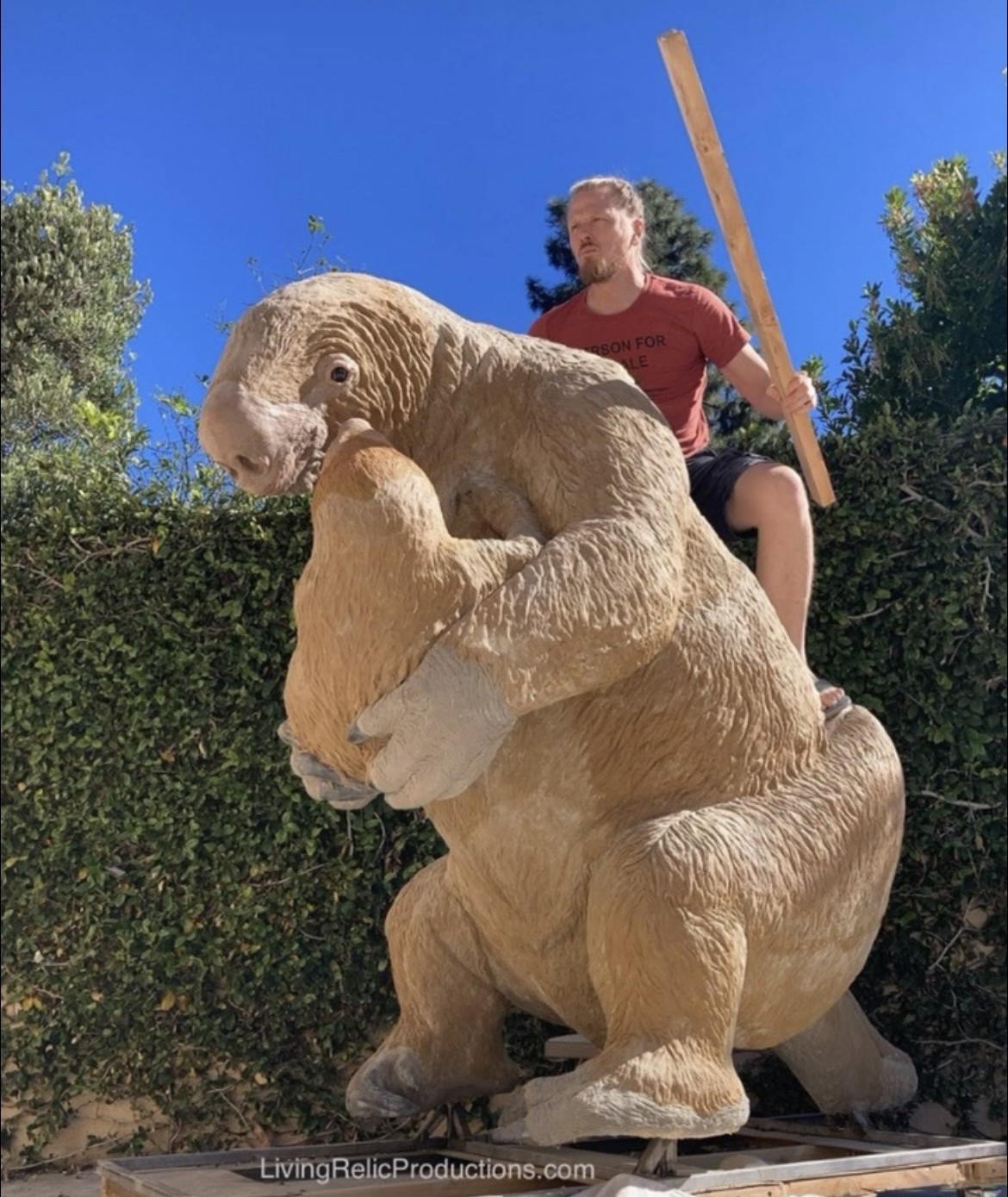
Artist and sculptor Brian Engh (left) created this life-like
depiction of ground sloth that is at the Children’s Natural
History Museum in Fremont. This
giant ground sloth is certainly an attraction to see.
This Paramylodon harlani lived in the San Francisco
Bay area during the Ice Age.
The statue is a realistic depiction of this Pleistocene
mammal. Brian worked with Gaetano Palazzo, Staff Paleontologist to
make it look like it was still roaming around the San Francisco
Bay area.
The ground sloth that
lived in Fremont was about 8 feet tall and weighed a maximum of
3,000 pounds. Its teeth were simple, consisted of dentine and had
no enamel covering. As the teeth wore down, they continued to grow
from their sockets. They had natural body armor made up of small
bony plates that developed on their skin called “osteoderms”.
Their hands and feet were armed with claws. Their front feet
rested on their knuckles while the hind legs bore down on the
outer edge of the broad feet. It is theorized that they walked
similarly to the modern anteater but sat on their tails to eat.
Ground sloths are thought to have evolved in South America and
migrated to North America during the Pliocene through the
Pleistocene. They are related to the living tree sloths.
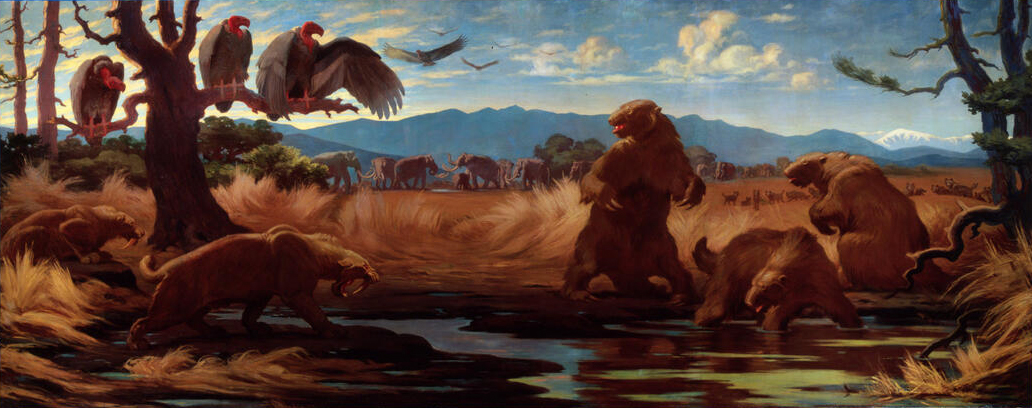
Charles Knight's
depiction of Paramylodon harlani
|