BACKGROUND:
Early humans did not have many materials available to fashion tools.
Steel, iron, plastic, and many other materials were not invented or
discovered until modern times. The only materials available were trees,
rocks, plants, minerals, and animal remains. Rocks and minerals were
important because many types are naturally hard.
 Some minerals were ground up and mixed with animal fat for use as
face paint or to create colors on cave walls. The red in many cave paintings
used hematite (an iron oxide mineral.) Minerals were also used as jewelry,
much as they are today.
Some minerals were ground up and mixed with animal fat for use as
face paint or to create colors on cave walls. The red in many cave paintings
used hematite (an iron oxide mineral.) Minerals were also used as jewelry,
much as they are today.
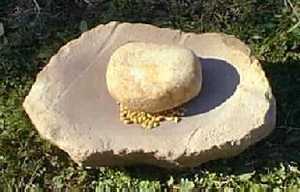
Rocks were converted into useable tools. For example,
large flat rocks were used as grinding stones (mortar and pestle). Wild
grains were crushed on them to produce flour. Many of these rocks were
well-cemented sandstone or igneous rocks (basalt in particular). Long round
rocks were then used to roll the grain mixture into flattened dough, which
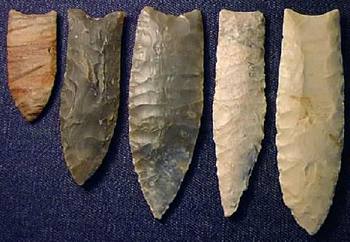
could be easily cooked over a fire. Rocks, like obsidian or chert (composed
of quartz), could be also fashioned into weapons. Arrowheads were
traditionally made from rocks like obsidian, which could be sharpened enough
to pierce the skin of an enemy or prey. Heavier rocks were used as blunt
instruments.
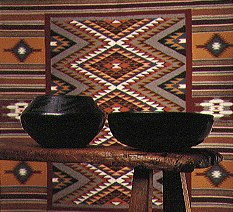
Even pottery requires clay from a pure mudstone.
Fine grained feldspar (a mineral) is also used in making some pottery better
than others.
PROCEDURE:
 Quartz and flint were used to make fire. Flint, agate, and obsidian were
used for knives. Sandstone, basalt, and granite were used for mortars
and pestles. Sulfur was used as a medicine. Early humans also used
ground minerals as pigment in rock paintings.
Quartz and flint were used to make fire. Flint, agate, and obsidian were
used for knives. Sandstone, basalt, and granite were used for mortars
and pestles. Sulfur was used as a medicine. Early humans also used
ground minerals as pigment in rock paintings.
- Use the Arrowhead Shapes worksheet and have the students look at the
different variety of shapes that were created. Each one was used
for a different function, especially to how the arrowhead was anchored
into the arrow.
- Instruct the students to imagine that they are early Native Americans
living in this country. You may want to list some of the Indian tribes
such as the Navajo, Hopi, Ohlone, Cherokee, Cheyenne, or Apache. Have
the students try to imagine what mineral and rock resources they would
have available, and how they would use them.
- If you have information on the Native Americans in your area, we
suggest you find out how they used rocks and minerals in their culture.
A local museum or college can provide information.