BACKGROUND:
Different types of building materials respond
differently to the shaking caused by seismic waves. Materials such as brick
and stone break easily during an earthquake. The mortar that typically holds
these materials together shakes loose; it has little strength. Brick, stone
and mortar structures are very unsuitable dwellings for "earthquake
country." In addition, non-bearing walls of bricks or stone are
extremely dangerous because they are not structurally part of a house. Wood
and steel are much better at withstanding seismic waves. Both of these
materials flex as the earth shakes.
Weak materials can be reinforced to make them
relatively safe. Reinforcing structures with a steel frame, or driving beams
through a structure will help support it during shaking.
PROCEDURE:
- Read Three Earthquake Dolls. Discuss with students what
would have fallen down or broken in each situation.
- Draw the chart on the different structures and how
they react in an earthquake on the board. Have the students predict how
each material will react to the shaking in a moderate earthquake. The
answers are written in the diagram, but make the students think before
you give them the answers.
| |
TYPE |
PREDICT HOW MATERIAL WILL
REACT IN AN EARTHQUAKE |
| A |
WOOD BUILDING |
very good |
| B |
STEEL BUILDING |
good |
| C |
BRICK BUILDING |
poor, especially if not reinforced |
| D |
STONE BUILDING |
poor |
| E |
ADOBE BUILDING |
poor |
| F |
GRASS HUT |
good (if roof is attached) |
- Discuss how these structures may be
reinforced. If you have the doll house, you may want to discuss ways to
reinforce structures inside the house. Go over each room. If you are
unfamiliar with reinforcing techniques, the Association of Bay Area
Governments website, http://www.abag.ca.gov/bayarea/eqmaps/fixit/fixit.html,
has excellent, up-to-date information
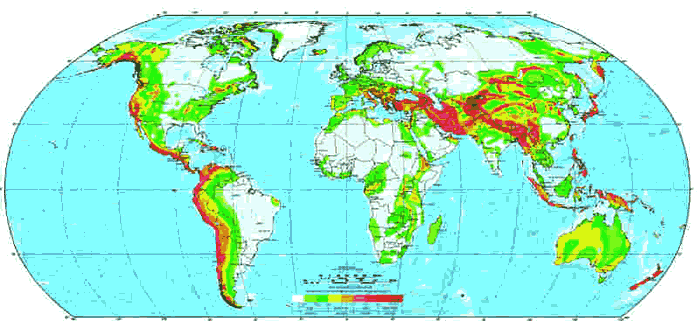
- Use a world map and go over areas that are prone to disasters caused
by earthquake. Point out the area around the Pacific especially from
Alaska to Indonesia region; west coast of United States, and Andes
Mountains. Areas around the India-China border is also active in
earthquakes. Excellent slides are also available from the National
Oceanographic and Atmospheric Administration (NOAA) at the website: http://www.ngdc.noaa.gov/seg/fliers/se-0801.shtml.

Red-browns are areas of highest earthquake risk. From Global Seismic
Hazard Assessment Program.
|